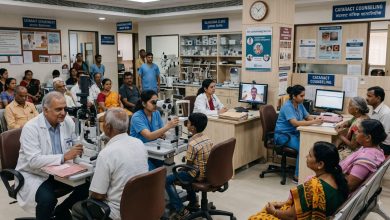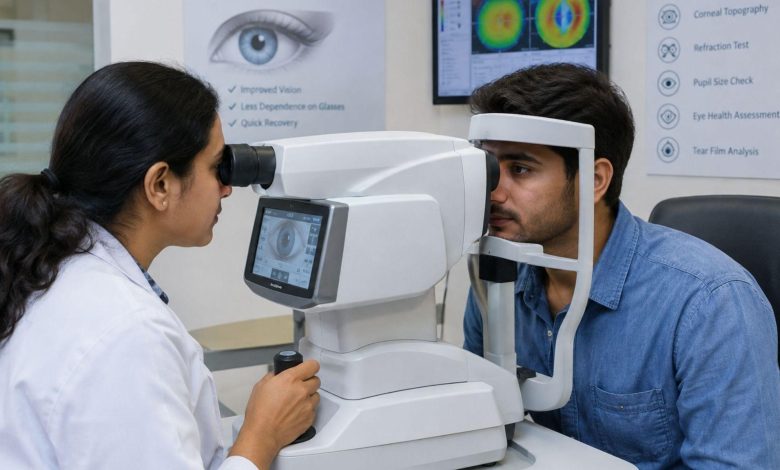
Before LASIK is approved, the eyes need to be examined carefully to make sure the procedure is suitable for the patient. Having a particular spectacle power alone does not confirm eligibility. The ophthalmologist looks at several aspects of eye health and vision before making a decision.
These tests help identify anything that could affect treatment planning, safety or recovery and allow the doctor to decide whether LASIK can be considered.
1. Eye Power Is Measured and Checked for Stability
A refraction test measures short-sightedness and astigmatism. The doctor also checks whether the prescription has remained stable.
LASIK surgery is considered when the refractive error falls within a suitable range, and there has not been a significant recent change in eye power. Unstable power may lead the doctor to postpone treatment and review the patient later.
2. Corneal Shape Is Mapped
LASIK surgery reshapes the cornea, so its shape needs to be studied before approval. Corneal topography or tomography creates a map of the corneal surface and structure. This can reveal irregularities that may affect treatment suitability.
When the corneal pattern is appropriate and the assessment finds no concerning changes, the patient can move to the next stage.
3. Corneal Thickness Is Checked
The doctor measures corneal thickness to determine whether enough tissue is available for the planned correction. This measurement is considered with the patient’s eye power and corneal shape.
If the cornea is suitable, LASIK surgery may remain an option. When it is too thin or otherwise unsuitable, another form of laser vision correction may be discussed.
4. Tear Film and Eye Surface Are Assessed
The tear film and eye surface are checked for dryness, irritation or other problems. Significant dryness can affect measurements, comfort and recovery.
LASIK surgery may therefore be delayed until the eye surface improves. A healthy tear film supports more accurate planning for laser eye surgery.
5. Pupil Size and Optical Quality Are Measured
Pupil size may be measured because it can influence treatment planning. Wavefront analysis may also be used to identify optical imperfections not shown by a standard spectacle prescription.
These findings help the surgeon decide whether laser vision correction is suitable and which approach may fit the patient’s needs. LASIK eye surgery cost can be discussed once the suitable procedure has been identified.
6. Overall Eye Health Is Examined
The ophthalmologist checks the overall health of the eyes before giving final approval. This may include examining the retina and other internal structures.
Existing eye conditions may need treatment or evaluation first. The surgery should only be approved when the wider examination supports proceeding with laser eye surgery.
Final Thoughts
A patient is approved for LASIK surgery only after all test results support treatment. Stable eye power, suitable corneal shape and thickness, a healthy tear film and satisfactory overall eye health are considered together.
No single test confirms eligibility on its own. If a concern is found, the ophthalmologist may delay treatment, recommend further assessment or discuss another vision correction option.