
What Materials Are Most Suitable For Durable Lecture Hall Chairs In High-Traffic Lecture Hall Seating Areas?

A busy educational venue places very different demands on furniture than a lightly used meeting room. Students may occupy the same seats for several hours, while desks and mechanisms experience repeated movement throughout the day. Consequently, material selection has a direct relationship with comfort, maintenance, structural stability, and service life. Lecture seating should therefore be assessed as a complete system rather than by appearance alone, and Leadcom seating provides one reference point for considering how different materials work together in demanding academic environments.
Understanding The Demands Of High-Traffic Academic Spaces
Large lecture rooms experience constant cycles of occupation, movement, cleaning, and rearrangement. A suitable chair needs to withstand these repeated actions without becoming uncomfortable or difficult to maintain. Structural components deserve particular attention because minor weaknesses can become noticeable after years of intensive daily use.
Material performance also depends on the environment. A university lecture hall may require different specifications from a private training room, even if both use similar furniture. Traffic volume, cleaning frequency, room temperature, expected service period, and maintenance resources should all influence the specification.
Steel For Structural Stability
Steel remains a practical choice for legs, supports, beams, and other load-bearing components because of its strength and established manufacturing methods. Powder coating adds a protective surface that can support routine cleaning while providing a consistent appearance. Properly designed steel structures can also accommodate the repeated loading associated with busy classrooms.
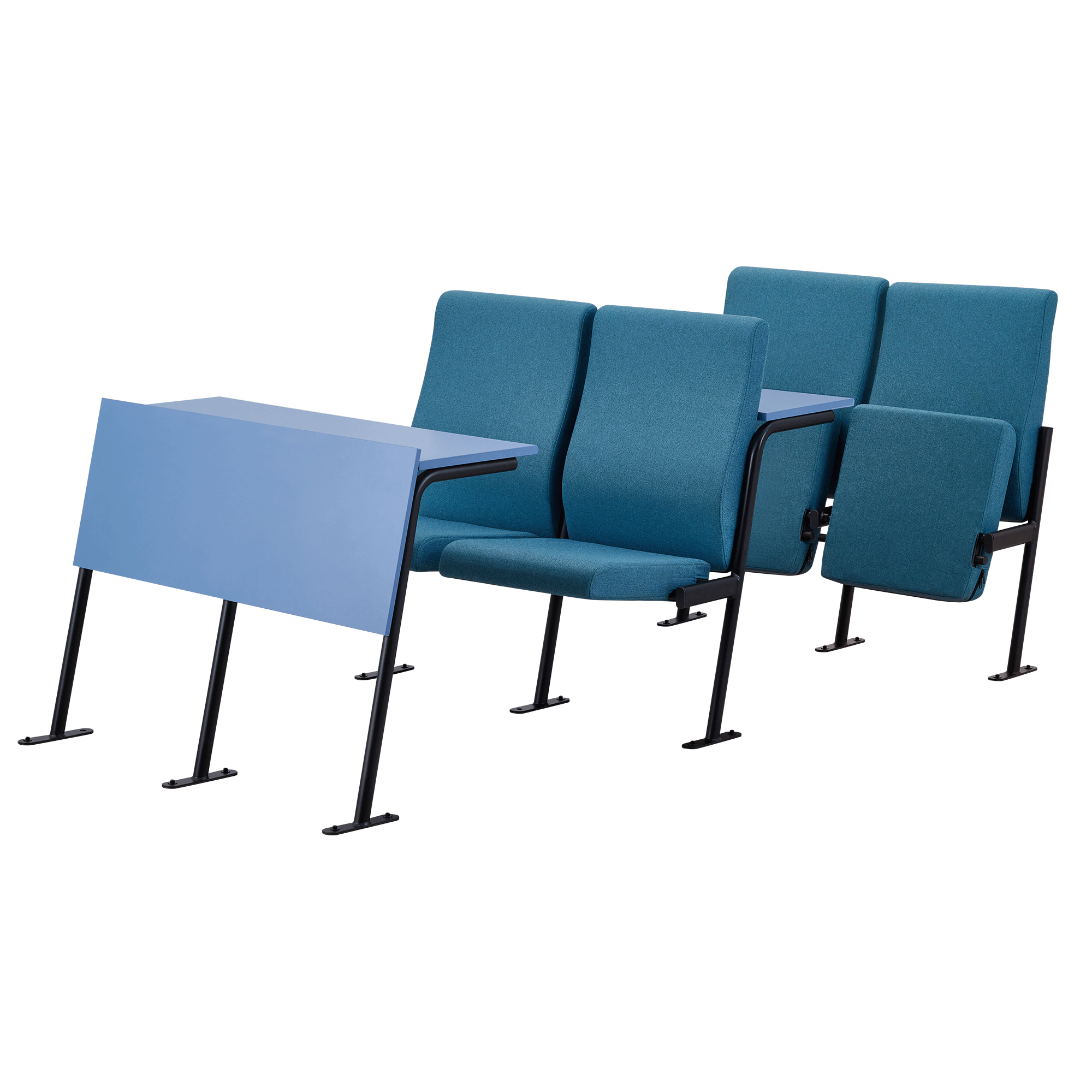
The Atticus L-E07 illustrates this approach through its high-quality steel, powder-coated legs. Rather than relying on decorative materials for structural components, the design places a durable metal framework beneath the seating and writing surface. Its counterweight tip-up mechanism also helps return the seat to its upright position after use.
Foam And Upholstery For Extended Comfort
Durability does not depend solely on hard materials. A chair intended for long lectures also needs a seating surface that supports the body without creating excessive pressure points. Cold-molded foam can provide a shaped cushion with consistent density, making it suitable for environments where students remain seated for extended periods.
The Atticus model uses cold-molded high-density foam for both the back and seat. This construction demonstrates how comfort materials can be integrated without turning the product into a heavily upholstered system. Such an approach can be useful in lecture rooms where ergonomic support matters alongside straightforward cleaning and maintenance.
Laminate And MDF For Writing Surfaces
A lecture chair often performs another function beyond supporting the student: it provides a stable surface for notebooks, laptops, or other learning materials. MDF with a laminate finish is commonly considered for this purpose because the surface can combine a uniform appearance with practical day-to-day usability.
The tabletop specification should be evaluated according to how the room is used. Frequent writing, laptop placement, cleaning, and occasional impact can gradually affect exposed surfaces. Edge treatment, laminate quality, thickness, and attachment method therefore deserve attention during procurement rather than being treated as secondary details.
Mechanisms And Material Compatibility
Even strong materials can perform poorly if the moving components are not suited to repeated operation. Tip-up seats are particularly useful in rooms where clear walkways are important, since the seat can return toward the upright position when not occupied. The mechanism must work smoothly while remaining compatible with the surrounding frame.
Atticus combines its steel structure with a counterweight tip-up mechanism, creating a compact arrangement that supports circulation between rows. This type of configuration shows why lecture seating should be evaluated through both material selection and mechanical design. A durable frame alone cannot compensate for a mechanism that is difficult to operate or service.
Balancing Durability, Comfort, And Maintenance
A material that performs well in one category may create limitations elsewhere. Heavy structural components can contribute to stability but may complicate installation. Softer upholstery can improve comfort but may require more attention during cleaning. Laminated surfaces are practical for writing areas, yet their long-term performance depends on construction quality and edge protection.
Procurement teams can therefore benefit from assessing each component according to its actual role. Structural metals, cushioning materials, tabletop surfaces, fasteners, and moving parts should be considered as interconnected elements rather than isolated specifications. Leadcom seating demonstrates this type of integrated approach through combinations of steel support, molded foam, laminate-finished MDF, and mechanical seat movement.
Conclusion
High-traffic educational furniture needs more than a visually appealing finish; its materials must match the physical demands placed on every component. Steel can provide structural support, molded foam can improve prolonged sitting comfort, and laminate-finished MDF can serve practical writing requirements. Mechanical features deserve equal attention because daily movement places additional demands on the overall construction. For institutions comparing lecture seating, a component-by-component review offers a clearer basis for specification decisions, while Leadcom seating can be examined as one example of how material choices and functional details can be brought together in an academic environment.

