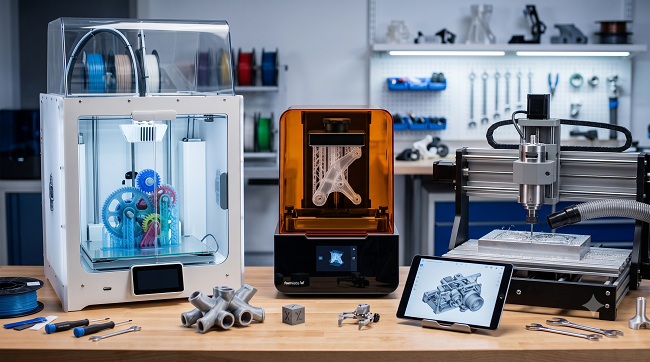
The world of desktop manufacturing has evolved rapidly, shifting from a niche playground for engineers to an accessible reality for local workshops, hobbyists, and small businesses. When setting up a workshop or upgrading a creative studio, developers often weigh the benefits of subtractive manufacturing, like using a traditional CNC Machine, against additive manufacturing techniques. Both paths offer unique advantages for creating custom parts, prototypes, and intricate end-use products. However, modern advancements have made additive systems incredibly versatile, allowing creators to build complex geometries layer by layer with remarkable precision and minimal waste.
Choosing the right ecosystem requires a solid understanding of the available technology, structural components, and raw materials. By diving into modern machine capabilities, mechanical upkeep, and filament characteristics, you can build a reliable production setup that matches your specific creative goals.
Resin Powerhouses and High-Resolution Engineering
For projects demanding microscopic accuracy and glass-like surface finishes, liquid resin systems have set an entirely new benchmark. Machines like the ELEGOO Saturn 4 Ultra 16K represent the upper echelon of consumer and semi-professional resin technology. Available in the UAE market for AED 2,900.00, this machine offers an astonishing 16K resolution that captures fine organic details, crisp mechanical threads, and flawless engineering prototypes.
Resin technology is highly favored by jewelry designers, dental laboratories, and miniature makers because it bypasses the physical limitations of physical nozzles. Instead of melting plastic lines, an ultra-high-resolution screen cures liquid photopolymer layer by layer. The result is a structurally isotropic part that requires minimal sanding or post-processing, saving immense labor time in a professional production environment.
The Versatility of Filament-Based Systems
While resin excels at visual perfection, fused deposition modeling remains the absolute king of structural durability, material variety, and large-scale manufacturing. Navigating the world of filament-based 3D printers opens up access to a massive marketplace of thermoplastic materials, structural replacement parts, and customizable hardware upgrades.
Filament machines build objects by melting thermoplastic spools and extruding them through a precise nozzle. A stellar example of an industrial-leaning desktop filament setup is the ANET ET5 Pro, priced at AED 2,000.00. This machine offers a generous build volume, allowing makers to print large mechanical housings, functional fixtures, or architectural models in a single continuous job.
To maintain peak performance in filament machines, the underlying hardware must be reliable and upgradable:
- The Mainboard: Upgrading to a 32-bit CPU mainboard equipped with silent stepper drivers, like the TMC2208, ensures incredibly smooth motor movements and whisper-quiet operation.
- Mechanical Belts: High-quality timing belts, such as the GT2 belt designed for the A8 Plus series, are vital for eliminating ghosting and artifact lines on printed surfaces.
- Extruder Assemblies: Reliable stepper motors keep filament feeding consistently, preventing under-extrusion issues during long, multi-day print cycles.
Navigating the Material Landscape: ABS vs. PETG vs. PLA
Choosing the proper filament color and chemical composition dictates exactly how your final product will perform under real-world stress. Each material features distinct thermal and mechanical profiles.
Acrylonitrile Butadiene Styrene (ABS)
ABS is an industry-standard engineering plastic valued for its high impact resistance, structural toughness, and heat tolerance. It is ideal for automotive components, protective cases, and functional mechanical gears. In the local UAE marketplace, high-quality 1.75mm ABS spools are highly cost-effective, with options like Anet White ABS or Generic Black ABS retailing at just AED 70.00 per kilogram. Specialized options like Blue ABS are priced around AED 75.00, while premium colors like Gold or Red range from AED 65.00 to AED 125.00 depending on the exact brand configuration.
Polyethylene Terephthalate Glycol (PETG)
PETG serves as the perfect middle ground between brittle plastics and temperamental engineering materials. It provides chemical resistance, exceptional layer adhesion, and impressive water resistance. Black PETG spools can be acquired for AED 95.00, making it an excellent choice for outdoor brackets, custom mechanical guards, and functional fixtures that need to survive environmental exposure.
Polylactic Acid (PLA)
PLA remains the absolute best material for swift prototyping, architectural concepts, and geometric models. It is incredibly easy to print, shrinks very little when cooling, and emits no harsh fumes. From basic 1kg Yellow PLA options at AED 90.00 to specialty 250g Green PLA variants at AED 135.00, this material offers unmatched color vitality and geometric stability for visual models.
Last Words
Building an efficient desktop manufacturing studio comes down to balancing raw machine power with premium materials. Whether you invest in an ultra-high-resolution resin system for fine details or a large-format filament machine for structural endurance, sourcing reliable components determines your ultimate success. By matching the right polymers to your specific design requirements, you can convert digital designs into high-performance physical realities smoothly and professionally.